
Entitled to Heels: Rooting to Fly
This is part III of the Entitled to Heels series.
If everything I’ve said in Part I (The Heel Effect) and Part II (What’s Your Game Plan?) is convincing enough, where does one start getting an entitlement to heels? Here are a few directions I’d suggest:
1. Learn what comfort means to you
In my work as a Feldenkrais practitioner, I see this a lot: most people don’t know what being comfortable in their skin means. We often confuse habitual and comfortable. But as women, we are especially conditioned not to take proper care of ourselves and to compromise on our well-being.
Practice: get a bunch of towels, blankets, bolsters, rollers or wedges, and lie down on the floor. Make yourself comfortable by using softer padding and filling the gaps between your body and the floor. I.e., a roller under your knees and ankles, a folded towel under your head and lower back, a little wedge under your shoulders … Experiment. Evaluate your comfort / level of relaxation. What else can be more comfortable? And even more? Check your breathing - it can change in response to more comfort. You can start noticing small things that didn’t use to grab your attention, but maybe now you can notice and change something about the discomfort you realise you have.
Same for your feet: they are very capable sensory beings, but when locked in the containers we call shoes most of the time, they learn to put up with discomfort and communicate less and less to your other parts. Start noticing what’s truly comfortable for your sensual feet, when they feel good, what sensory inputs they like.
Once you know what is comfortable, and how your life can be more comfortable, you can apply this knowledge to your dancing: posture, embrace, connection, clothing and shoes. If any of it doesn’t feel right, it needs to be changed! And this is going to be a work in progress, as there are always further layers of comfort.
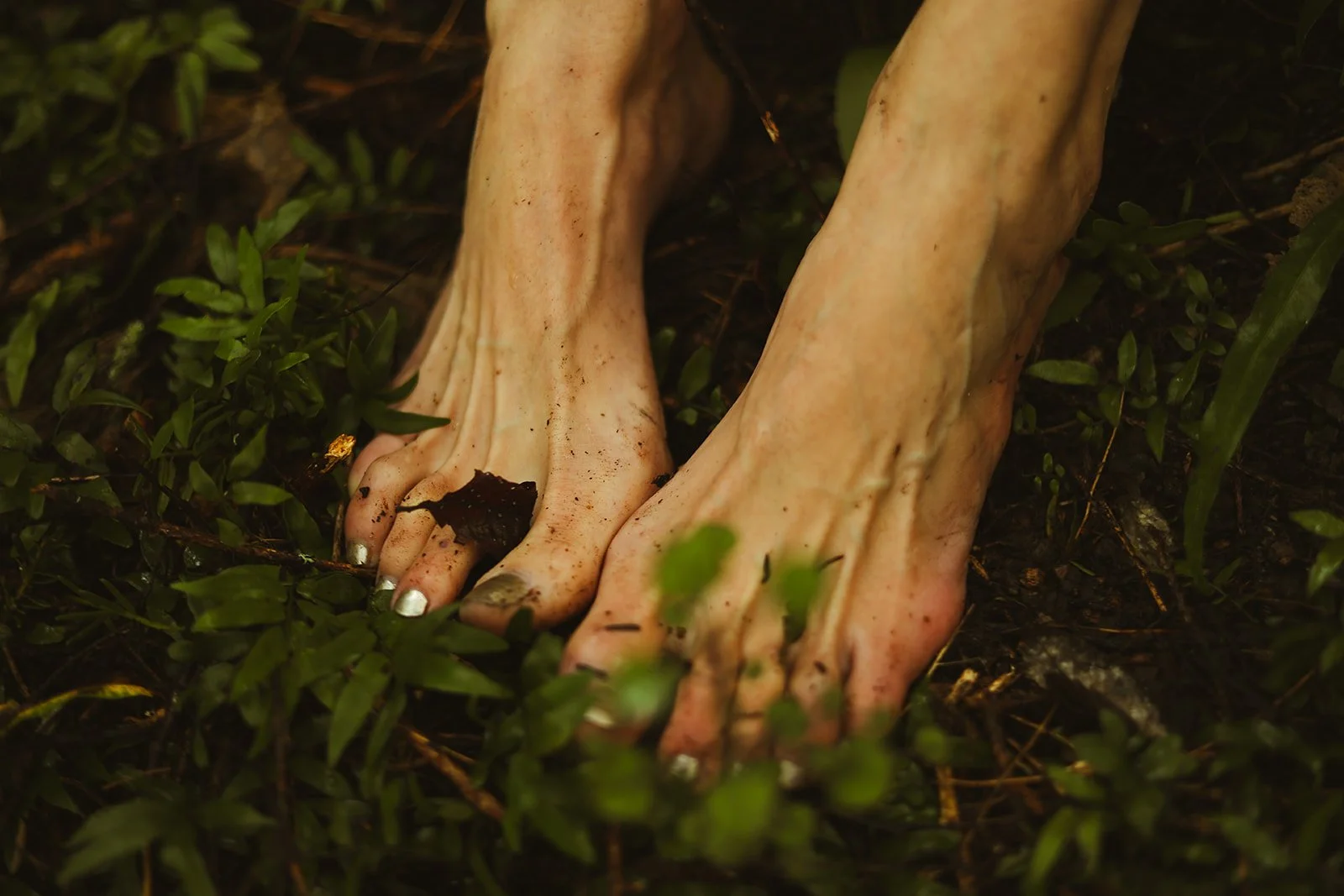
Photo by Elena Kotliarova
2. Learn about your feet' anatomy
Anatomy doesn’t have to be boring, especially when taught functionally and experientially. Our feet are quite fascinating by design, and learning about them will make you appreciate them and help establish a better relationship with them.
"The human foot is a masterpiece of engineering and a work of art."
Da Vinci.
The goal here is not to memorise the names, but to try to translate what you see and learn into the felt sense of your own foot.
Practice. You could watch some anatomy videos, for example:
Foot and ankle bones by Sam Webster
The simplified foot by 3D Anatomy Lyon
Foot muscular organization and function by 3D Anatomy Lyon
Foot Anatomy Animated Tutorial by Randale Sechrest
Or if you love colouring in, there are anatomy colouring books - another fun way to learn about what’s inside you.
Once you understand the real estate of your foot better, use your own hands to palpate those bones and joints and get familiar with them. As if you wanted to create a kinaesthetic X-ray of your foot using your touch.
A Feldenkrais class can be a fun way to learn anatomy experientially - but you might need to ask your teacher specifically about what interests you. Our students' curiosity is the best reward in our profession, so please don’t be shy.
3. Get a foot health assessment
In my ideal world, it would be done before you put your first heels on. But better soon than never. And then, do something with the results and recommendations. Be careful, though, when looking for a podiatrist or another professional helping you: you must be sure they think human feet are amazing, not flawed, and see orthotics and corrective shoewear as a temporary relief measure, not the ultimate solution. In most cases, orthotics should come with an exit plan, just as the pain relief medication.
An easy and fun way to do a self-assessment (although obviously limited) is the “How Fit Are Your Feet?” workshop from Gait Happens.
You can also look at your movement and holding habits in the areas of your hip joint, knee, and ankle. It’s a two-way highway, and what you do there can influence the way you load your feet, too. This should be a part of your foot health / gait assessment.
Photo by Elena Kotliarova
4. Awaken your feet’ intrinsics and let them do their work
If you wear conventional footwear most of the time when you are not dancing, and don’t do anything to create movement within your feet, they are likely to be systematically underloaded and movement-starved. Yet on the dancing floor, you put on them a high, nearly impossible demand: not only to carry the biggest load in your body, but to do it on a smaller surface, in high-impact situations like pivoting, using muscles that are simply not prepared. The foot intrinsics are small but powerful if you give them a chance to kick in and do what they are meant for: stabilise your foot arches and the ball of the foot (MTP joints), as well as allow transition between support and propulsion in the gait cycle.
A. Check my previous blog posts on Proprioception and Curled Toes. Balance and feet conditioning go hand in hand (or shall I say foot in foot?) Use the free video series I offer. Find a programme that you enjoy and is fun to follow. It doesn’t have to be big. You’ll find more suggestions in the Resources section below.
B. Get your own “feet gym” equipment: blocks, half-rollers, balance boards, toe spacers, cork or massage balls, bands, mats, marbles, pens, lego pieces (the last three to be picked up with your feet) ... Whether specially made or gathered from what’s available in your home, it doesn’t take much space (except for lego, if you know, you know). You can easily bring some of those items to your regular gym session to use in the breaks between working out your other muscles. At home, keep it somewhere where you come often and can use it “en passant”: balls and mats in the kitchen, bands by the coach, balance board in front of your dressing mirror … (the lego will find its way to your feet anyway!)
C. Consider switching to minimalist shoewear, but keep in mind it might require a transition period. It doesn’t have to be fancy, as long as your shoes have: a) heels level with the front (0 drop); b) a wide toe box; c) a flexible sole, fully connected to the top of the shoe (no flip-flops/jandals). A good and fun exercise would be tracing your bare foot on a piece of paper, then comparing this shape to that of the shoes you wear most often.
5. Get curious, play and experiment
A curiosity and experimentation mindset will help you to engage and maximise the usefulness of your “training” sessions. Look at babies, puppies or kittens: they don’t get stronger by doing a set number of mindless repeats. Healthy babies generate a variety of different experiences for themselves if the circumstances are right. What your brain does best is choosing from a variety of sensory experiences and turning them into the most precise action you need.
With shoes, try different options. Find your ideal heel height and position. Take into consideration your foot size: the smaller the foot, the bigger the heel impact. Find out how many tandas you can usually tolerate well on heels, switch to lower heels or flats if necessary.
Remember that flats will require a slightly different technique.
Exactly as with the shoes, there is no universal practice or care routine where one size would fit all. Find an active approach that feels fun, doable, and makes sense to you. And remember: it’s not just about muscles. See any conditioning and technique as something that allows you to become more of a sensing being that is free to creatively express through movement.
Photo by Elena Kotliarova
After all, if there's something I know about dancing tango, it is this:
Suffering is dispensable,
Pain is not necessary,
Dancing and moving must feel comfortable,
No matter age or role.
If you want more of this kind of content, you can subscribe here and get my 4-part video series with very doable foot care "routines" and fun movement explorations.
Extra resources:
Adapting your technique to flats with Yelizaveta from IMSOTango:
Follower technique for dancing in flats
Flats vs. Heels: the technique every tango follower needs
Tango-specific foot explorations I checked and liked:
Feet Ramps by Candela Ramos
Anatomical and biomechanical insights + guided movement practice
Biomechanics on the Block classes by Virginia Vasconi
Balance, stability, proprioception, and awareness skills
DancerShape - Tango & Yoga - A Tango Daily Routine for your Legs
Feet & ankle stability exercises and release / stretch routines
General foot health resources I recommend:
Katy Bowman: Nutritious Movement - Walking Well course
Katy Bowman: free Feet, Footwear, and Walking Resources
Katy Bowman, Whole Body Barefoot - Transitioning well to minimal footwear (book)
Gait Happens: The Fit Feet Program
The feet “gym” kits - available near me, you might have other brands in your part of the world:
The Rehab Mechanics
(use TRTR2020 as storewide promo code to get 15% off, courtesy Frank)
If you know a resource you’d love me to review and add to the list, please let me know.